Active zodiac degrees: where the pearls are born
Every degree of the zodiac has its own character in the DestinyKey degree passport. But a description is one thing and a measurement is another. We asked a simple question: are there degrees in which the world's most famous people are born noticeably more often than everyone else? There are, and they can be listed.
Pearls and ore
We took from Wikidata every person born between 1800 and 2005 with an exact date of birth — 177,765 people. Fame was measured in the most neutral way available: the number of language editions of the person's Wikipedia article. The more languages, the wider the world knows them.
The first thousand on that list we called the pearls — people whose names are known on every continent. The remaining 176,765 are the ore: notable people too, each with an article, but on a different scale. Comparing pearls with ore is not comparing celebrities with ordinary people; it is comparing the highest degree of manifestation with the ordinary one. That is precisely the question astrology asks: which degrees give the power to manifest.
For each person we computed the Sun, Mercury, Venus, Mars, Jupiter and Saturn at noon Greenwich time — without a birth time the Moon, houses and Ascendant cannot be computed, so they are not in the study. Then for each of the 360 degrees and each planet we compared how many pearls were born in that degree with how many would be expected if pearls were distributed like ore. We call the ratio the power of the degree. A power of 2 means pearls are born there twice as often as ore; 0.5 means half as often.
Three tiers of fame
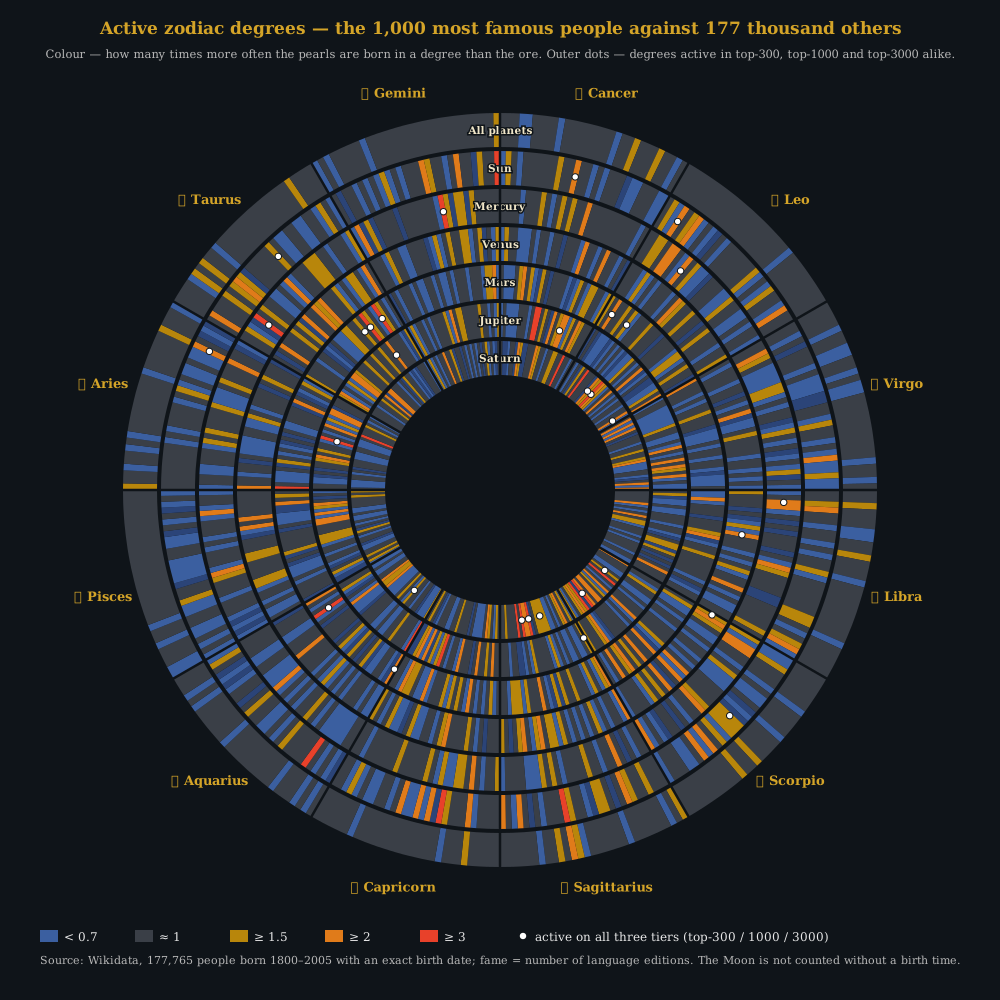
A single list of a thousand names could produce random spikes. So every degree was tested three times: on the first 300 people, on the first thousand and on the first three thousand. A degree that is active on all three tiers — a power of at least 1.5 and at least three people on each — receives three stars ★★★. These are the degrees that work both at the top of the list and on its slope, and they are the ones marked with white dots on the chart.
What the chart shows
The chart reads like a natal chart: 0° Aries on the left, signs counter-clockwise. Seven rings — outermost all six planets together, then the Sun, Mercury, Venus, Mars, Jupiter and Saturn at the centre. Cold blue is a power below 0.7: pearls are born there less often than ore. Grey is around one, a neutral degree. Gold is 1.5 and above, orange 2 and above, red 3 and above.
Sun. The strongest Sun degrees on all three tiers: 14° Cancer (power 2.9), 4° Leo (2.8), 26° Aries (2.5), 17° Taurus (2.0), 15° Scorpio (1.7). Note that none of them are in mutable signs.
Mercury. 19° Gemini (3.5) is the strongest Mercury degree and one of the strongest overall — Mercury in its own sign. Then 6° Taurus (3.1), 3° Libra (2.9), 10° Leo (2.4).
Venus. Venus has the fewest active degrees; it is spread more evenly around the zodiac. Two are stable: 11° Libra (2.4), Venus in its own sign, and 1° Scorpio (1.7).
Mars. The most contrasting planet. 26° Taurus (4.2) is the strongest degree of the whole study: pearls are born here four times more often than ore. Next to it 22° and 20° Taurus (3.3 and 2.0) — a whole band of active Mars in the sign of its detriment. A second band is Aquarius: 26° (3.6) and 1° (2.8). A third is early Leo: 3° (2.5) and 8° (1.8).
Jupiter. 17° Aries (3.0), 21° Cancer (2.3) — Jupiter in its exaltation, 23° Taurus (2.1), 1° Sagittarius (1.6) — Jupiter in its own sign.
Saturn. Second in contrast after Mars. The band 18°–21° Sagittarius (3.6 and 4.0) plus 13° Sagittarius (1.5); the Leo band — 12°, 14°, 29° (2.0; 3.5; 2.8); Scorpio — 8° and 22° (1.7 and 3.0); 11° Aquarius (1.9), Saturn in its own sign.
Degrees where several planets meet
The most interesting degrees are those active for several planets at once. That is no longer a property of the planet but of the place in the zodiac itself:
- 26° Aries — Sun, Mars and Jupiter; - 18°–21° Sagittarius — Saturn, Jupiter and Mercury; - 6° Taurus — Mercury and Venus; - 26° Cancer — Sun and Mars; - 17° Scorpio — Venus and Saturn; - 11° Libra — Venus and Mercury.
In the DestinyKey degree passport these degrees get a separate line, "Pearl activity", with the power and tiers — and in a natal reading, if one of your planets stands in one of them, you will see it.
How to read it in your own chart
An active degree is neither a guarantee of fame nor a verdict. It is a degree in which the planet's energy more often comes out, becomes visible to others. A power of 3 for Saturn at 21° Sagittarius means that among the world's most famous people there are three times more with Saturn in that degree than there should be — so Saturn there does not hide but builds a biography in plain view. A cold degree means the opposite: the planet works, but more quietly, inward, and asks the person for a conscious effort to bring it out.
We did not filter the results through statistical thresholds, and that is a deliberate choice. Astrology starts from the premise that a planet's position determines character; our task is to measure where that determination shows most strongly and hand the user a map of those places. The threshold of three people and one and a half times protects against single coincidences, and the three tiers test for stability. Everything else is on the chart, as it is.
Three studies, one methodology
This article closes the series. In the first we tested the Gauquelin method on 177 thousand charts and found the same key zones of Mars, Jupiter and Saturn that he did. In the second we ran all 45 planetary pairs through every aspect and found the pearl aspect: the conjunction of Venus and Pluto. In the third we measured the power of every degree. All three results are built into DestinyKey readings: the Gauquelin method as a block on the natal page, the pearl aspect as a line in the chart data, active degrees as a line in the degree passport. The methodology is described on the Methodology page.