Google de-ranked my site in a day. Users spend 13 minutes on it. Here's the data.
I'm a professional astrologer, and I run DestinyKey alone. It takes a date, time and place of birth, casts the chart and writes a full personal reading from it — natal, synastry, horary, solar return, transits. Not "you're a Taurus, so you're stubborn", but 1,500–2,500 words on one specific chart, using an author's method (degree passports). 18 languages, ~65K pages: ~500 of them are the tools; the rest is a reference layer — charts of famous people, companies, historical events and cities, computed by the same engine.
This isn't about astrology. It's about what happens to a young site in Google in 2026. Swap in any product; the story is the same.
What happened
Until July the site grew the way a young project should: ~100 clicks and ~2,500 impressions a day from Google, average position 12.
On 19–20 July 2026, over two days, impressions dropped from 2,500 to 70 a day (−97%). Clicks −80%. Average position went from 12 to 21. The drop was sitewide: the interactive tools people actually come for disappeared along with the reference pages.
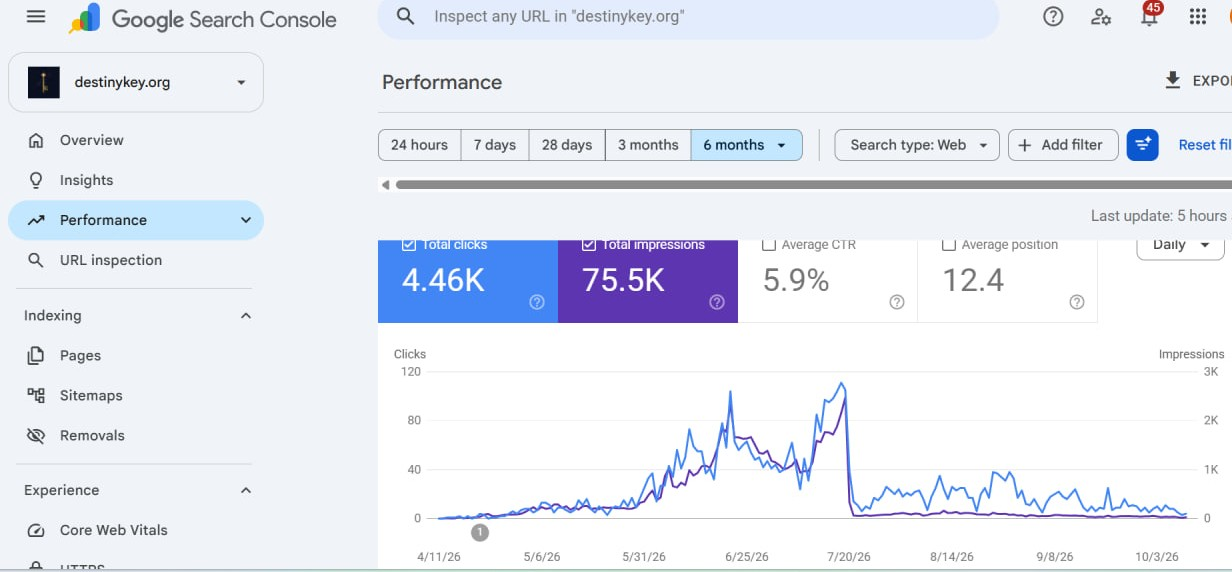
No manual action. No security issues. The server was clean: zero 5xx, Googlebot at peak crawl that week. Google announced nothing — but independent SERP trackers (Mozcast, SEMrush Sensor, Sistrix and others) logged heavy volatility on exactly those days. Since July 2026 Google has acknowledged that smaller core updates roll continuously and unannounced.
Almost three months later, Search Console shows about 20K pages indexed — and they get ~35 impressions a day. This isn't an indexing problem: the pages are in the index; Google just doesn't show them to anyone.
What users do meanwhile
Google can't see one thing: people like the site.
GA4, last 28 days: 21,275 pageviews, 6 minutes average engagement sitewide. Horary page: 13:31. Synastry: 13:52. Natal chart: 11:23. Typical engagement for content sites is around a minute.
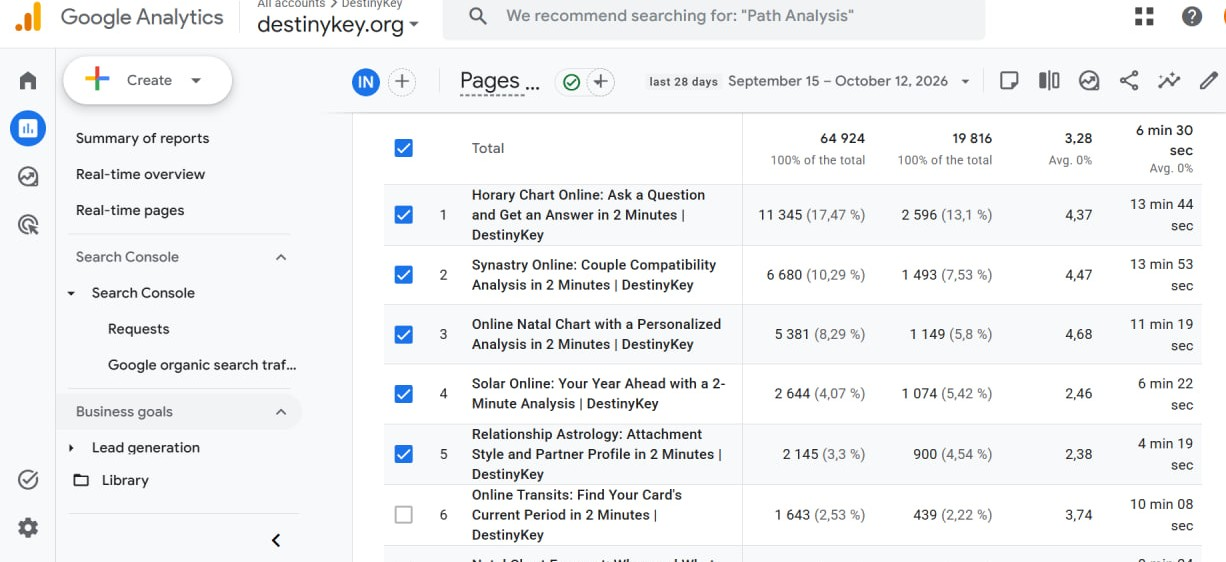
People come, enter their data, read the reading, come back, pay. Where from, if not Google?
What the other engines see
Yandex. On the day Google switched the site off, Yandex noticed nothing: 31 July — 6,964 impressions, 481 clicks in a day, 20× Google on the same day. Live queries: "natal chart", "synastry online", "horary online".
Bing. Steady growth since mid-August, more every week. Bing is the only source of non-Russian search traffic.
ChatGPT. In 14 days OAI-SearchBot crawled 16,000 pages, GPTBot 13,000. More telling: ChatGPT-User — the agent that opens pages live while answering a real person — fetched our pages 1,756 times in two weeks. ChatGPT already answers people from our pages; the first visitors are arriving from its citations.
Four independent systems — Yandex, Bing, ChatGPT and the users themselves — find the site useful. The fifth, with 90% of the market, doesn't.
What a Google Product Expert said
I posted on the official Google Search Central forum. A Diamond Product Expert — the top tier of Google's volunteer experts — replied, verbatim:
> "With that amount of pages and low authority, you will need to wait more than that for Google to crawl all the pages. In any case, I don't know if you will see any improvements. Even if you deindex all the AI slop, Google is indexing fewer utility tools nowadays."
"Low authority." Authority, to Google, means links from other sites. A young site has few, because links appear when a site is found — and sites are found through Google. The loop is closed, and Google closes it: old sites with accumulated links get traffic, traffic earns links. A new site, however good, never enters the loop.
"AI slop." The expert spent a couple of minutes on the site, saw 60K pages of one format, and called it AI slop. This is the main charge, and it deserves its own section.
It's not scale. It's a database.
The 60K pages don't exist to flood the index. They exist because astrology without a database is guesswork, and with one it's research.
To say the 29th degree of Capricorn is "strong", trusting old books isn't enough. You take thousands of charts of people with known biographies and check which degrees their planets occupy versus a random distribution. For an ordinary user's reading to be a comparison rather than generalities — "your Venus sits in the same degree as Marie Curie's and Frida Kahlo's" — you need a corpus to compare against.
That corpus is the "mass pages": 540 charts of famous people, 343 companies, 374 historical events, 750 cities, all 360 degrees of the zodiac. On it we measured the power of degrees, the power of aspects, planet–star conjunctions. Every page in it is a reading, not a stub. Open Google's own chart or the article on Google's two charts — and call it slop.
The site is one organism. The tools people love work because this base sits under them. I'll grant that Google may not want to rank reference pages. Fine — don't rank them. But to cut off nearly all traffic to a site where people spend thirteen minutes, because it has a big reference section, is plainly not acting in users' interest.
"Google is indexing fewer utility tools nowadays." The most honest thing I heard. Google is deliberately shrinking the share of tools and services in its results. For a user it means: search "natal chart reading" and you get an article titled "what is a natal chart" from an old site — not the service that would write you the reading. They'll never learn the thing they searched for exists.
Who the results actually serve
About three quarters of Alphabet's revenue is advertising, most of it search ads. Google's results page is a storefront where the first screens are sold. Organic results are what's left below.
Which site benefits from organic results, from Google's point of view? The old, established one: Google can't extract anything from it, so showing it is safe and free. And which site needs organic results most? The young one — with a product and users but without fifteen years of links. It's the only one willing to pay to be seen. And it's the only one Google removes from organic results.
I'm not claiming someone at Google presses a "hide the young site" button. I'm claiming that a monopolist has a direct financial incentive to tune the algorithm this way, and the algorithm's output matches that incentive exactly. In the US antitrust trial it emerged that Google had tuned its search ad auction in ways that raised advertiser prices. A company that tunes the auction for revenue has no principled reason to keep organic results out of the same logic.
The contradiction Google can't explain
Left — user behaviour: 6 minutes on site, 13 on a reading, returns, purchases. Right — Google's decision: 35 impressions a day across 20K indexed pages.
Google says it "puts the user first". But it doesn't weigh whether people like a site. It weighs domain age, links, and how much a site resembles the ones it already shows. The results select for what's convenient and profitable for the platform, not for what the user needs. A person typing a query won't be shown the site they need — they'll be shown the site that's profitable for Google. They don't know this. They think Google searches. Google doesn't search — it allocates attention the way that profits it, and calls it "quality".
What Google's policy should say
I'm not asking Google to change its algorithm. I'm asking for honesty in wording. If Google can't explain why a site with record time-on-page is shown to no one, the policy should state plainly:
> "We show you not the sites you need, but the sites it's profitable for us to show you. New sites, even better ones, will appear once they've paid for ads or existed long enough."
The obligation already exists. EU Regulation 2019/1150 (P2B) requires search engines to publicly describe the main parameters determining ranking and their relative importance. Directive 2019/2161 requires disclosure of the main ranking parameters — precisely because hiding them is deemed misleading to consumers. Google complies with a page of generalities: "relevance, quality, usability". It omits the parameter that decides everything — domain age and accumulated links. It's like printing "contains: tobacco" on cigarettes instead of "smoking kills". The consumer has a right to know what they're using: a tool that finds what they need, or a storefront that shows what the platform needs.
A US federal court found Google a monopolist in search in 2024. In 2025 the European Commission preliminarily found Google in breach of the DMA. That's not my opinion; governments have put it on record. I'm only showing what it looks like from a site that users need and Google doesn't.
If you're just searching
The first screen of Google is ads. The organic results below aren't "the best of the web" — they're "the oldest and safest for Google". If you need something specific, ask more than Google: Yandex, Bing, ChatGPT and Perplexity show different sites, often the ones you need. They find mine. Google doesn't.
If you build sites
Google is weather, not a channel. Submit to Bing on day one — that's Copilot and ChatGPT search too. Let the AI crawlers in. Measure time on site and returns, not traffic. And if Google switches you off — don't run to buy ads from the company that switched you off. Collect the data. Write it up. That is your authority.
I have nothing to lose with Google. Users like the site — the only thing in this story that matters.